Tuesday, 25 June 2019

France 1979 - Tourism Series (Part 7)

It was the product of an inherited fortune. It employed an architect so obsessed with perfection, he razed whole sections of the building to the ground if they didn't meet with the approval  of his hyper-critical eye. From the time of its construction in 1630 till 1905 when it was purchased by the state, it passed through the hands of no less than seven different families. It was even visited by Louis XIV in April 1651.

***

The Château de Maisons, which is now called Château de Maisons-Laffitte, is located in Maisons-Laffitte, a northwestern suburb of Paris, in the department of Yvelines, Île-de-France. Construction of the château was commissioned in 1630 by René de Longueil using the funds from a fortune inherited by his wife, Madeleine Boulenc de Crévecœur, who died six years later in 1636, never to see the fruits of her inheritance. By 1651 the château was complete, and it was in this year that it played host to King Louis XIV in April.

The Château de Maisons was designed by François Mansart in the French baroque architectural style. According to a pamphlet entitled, La Mansarade, the architect realised, after completing the construction of the first floor of the château, that he had committed an error in the plans  So in a ludicrously egocentric move, he apparently razed everything built so far to the ground in order to start afresh! A tall tale? Who knows. But it certainly makes for a compelling story.

René de Longueil died in 1677, and the château remained in his family until 1732. Between that date and 1905 it passed through the hands of no less than seven families. Too many to list here. For a full history of the château, click HERE. In 1905, the State purchased the château in order to save it from demolition. Then in 1914 it was deemed an historical monument. 

***

On 9 July, 1979, France issued a set of seven stamps in their ongoing Tourism series. To read the previous six parts, simply click on the relevant link. Part 1. Part 2. Part 3. Part 4. Part 5. Part 6. In this blog I'll take a close look at the final stamp in this series, the 0,45 value. This stamp depicts the Château de Maisons, which is now called Château de Maisons-Laffitte. This stamp was designed and engraved by Pierre Forget. Contrary to the stamp depicting an architectural monument that I studied in Part 6, I think this one is a true stunner. A far  more interesting and visually appealing design than the stamp shown in Part 6. But that's just my humble opinion.


This stamp has, in my eyes, a somewhat Decaris-esque quality. If compared to Decaris' 1946 Luxembourg Palace design, we can see a marked similarity of line style.


***

Indeed, even the 1948 Saarland architectural stamp by Decaris bears some similarity, I feel.


Until next time...


Friday, 21 June 2019

France 1979 - Tourism Series (Part 6)

For several centuries it was considered one of the richest, if not the richest, of Abbeys in France. It was the hub of intellectual life in the French Catholic church, housing one of the most important scriptoriums in the country. It was pillaged and burned by Vikings, then like a phoenix rising from the ashes, it  was restored to its former glory only to have portions blow up, towers collapse and other forms of atrocious wonders. This is the Benedictine Abbey of Saint-Germain-des-Prés in Paris.

***

Founded in the 6th Century by Childebert I, who was the son of Clovis I, the Abbey of Saint-Germain-des-Prés was built on the outskirts of early medieval Paris, in a region of the Left Bank that was quite prone to flooding from the Seine. Consequently, it was established on slightly raised meadow land, known in French as a prés. Hence the name it has been given. By the 9th Century it was already considered one of the richest abbeys in France, as evidenced by its polyptych (an inventory of properties owned by the church). It was also in this century that  it was the victim of several Viking onslaughts, which left parts of the church grounds little more than smoking ruins. By 1014 it had risen from the ashes and was restored to something akin to is former glory, possibly even more glorious. 

Over the course of the next two centuries, its riches and stature grew, and by the 11th Century, the church contained what was considered an "important" scriptorium, a polite way of saying a kick butt library! In fact, the abbey was the hub of the Catholic church's intelligentsia right up until the French Revolution when it was disbanded. But this wasn't the end of the destruction inflicted upon the abbey. In 1794 a fire broke out completely destroying its library. And at some point (I'm assuming around this time but haven't been able to find a date yet) an explosion of stored saltpeter totally levelled the abbey and its cloisters. Only the church itself was spared in this particular disaster. To this day the abbey church remains as the Église de Saint-Germain-des-Prés. It is one of the oldest, and perhaps one of the most unlucky, churches in Paris.

***

On 9 July, 1979, France issued a set of seven stamps in their ongoing Tourism series. To read the previous five parts, simply click on the relevant link. Part 1. Part 2. Part 3. Part 4. Part 5. In this blog I'll take a close look at the 1,40 stamp, which depicts the Abbey of Saint-Germain-des-Prés. This stamp was designed and engraved by Jacques Gauthier. This stamp has been executed in a 2D front elevation style akin to an architectural drawing. Personally, I'm not very partial to this design. For an abbey with such a remarkable history, I would have thought a stamp with a far more dynamic representation of the building was in order. I'm sure there are those out there that love its detailed simplicity. And that's totally fine. But I don't. I consider it rather boring. 


Until next time...


Wednesday, 19 June 2019

France 1979 - Tourism Series (Part 5)

The last battle of the Breton War of Succession was fought here in 1364. In 1776, at the beginning of the US War of Independence, Benjamin Franklin came through here in his way to meet with Louis XVI to seek military aid. In 1795, 750 rebels were shot and buried here. Its train station was of vital strategic importance during WWII. Its inhabitants are called Alréens. This is Auray, a commune in the Morbihan department in Brittany, northwestern France. Aside from its rather checkered history, Auray is home to some breathtaking architecture. From bridges and fountains to churches and stunning timber houses, a stroll through the city is well worth it.

***

On 9 July, 1979, France issued a set of seven stamps in their ongoing Tourism series. To read the previous four parts, simply click on the relevant link. Part 1. Part 2. Part 3. Part 4 In this blog I'll take a close look at the 1,00 stamp, which depicts a gorgeous wooden house in the town square of Auray. This stamp was designed and engraved by Claude Haley. This particular stamp is quite special in that it won Haley the 1979 Philatelic Art Grand Prize. A very worthy winner. This stamp is crammed with an amazing level of detail.


Until next time...


Tuesday, 18 June 2019

France 1979 - Tourism Series (Part 4)

Ever wondered what a stamp would look like as a playing card? This is a question French stamp engraver and designer, Pierre Forget, set out to answer in 1979 to commemorate Norman abbeys. Two abbeys were chosen for this cutting edge stamp design: the Abbey of St-Pierre-sur-Dives and Bernay Abbey. Without further ado, let us delve...

***

Its stunning towers loom large over the sleepy town of St-Pierre-sur-Dives. The Abbey of St-Pierre-sur-Dives, Abbaye Saint-Pierre sur Dives, was founded in the 11th century by Countess Lesceline, who happened to be the great-aunt of William the Conqueror. It was originally built to house a community of nuns. At some point over the course of the next century, the nuns were replaced by Benedictine monks from the Abbey of the Holy Trinity in Rouen. The abbey as it stands today is very different from its original design. It was rebuilt between the 13th and 15th centuries, during a time known as the Gothic period. Having said this, the church still contains the tomb of its founder, Countess Lesceline.

Bernay Abbey, Abbaye Notre-Dame de Bernay was founded in the 11th century by Judith of Brittany. Judith was the daughter of Conan I of Rennes and wife of Richard II, Duke of Normandy. The original design was ahead of its time, being one of the first examples of Romanesque architecture in Normandy. The church was listed as an historic monument in 1862.

***

On 9 July, 1979, France issued a set of seven stamps in their ongoing Tourism series. To read the previous three parts, simply click on the relevant link. Part 1. Part 2. Part 3. In this blog I'll take a close look at the 1,00 stamp, which depicts both Abbey of St-Pierre-sur-Dives and Bernay Abbey in a funky playing card style. This stamp was designed and engraved by Pierre Forget. 


This stamp is truly fantastic. The top half commemorates Abbey St-Pierre-sur-Dives. At the bottom of the stamp, in the inverted style of a playing card graphic, is a representation of Barney Abbey. Aside from the glorious engravings of the church interiors, this stamp has a couple of other interesting features. If you look to the top right, you will come across this...


Forget has ingeniously added the letter N for Normandy in theform of a vault in the ceiling. Below this we see the letters AA forming a cross with a Cross of the Abbey,. The AA stands for A year of Abbeys. Pretty cool.

Until next time...


Saturday, 15 June 2019

Andorra 1944 - Definitives (Part 3)

Andorra is a landlocked sovereign microstate on the Iberian Peninsula, in the eastern Pyrenees. It borders Spain to the south and France to the north. It is traditionally believed that Andorra was created by Charles the Great (Charlemagne) in the 8th century where he was said to have installed some five thousand soldiers in the area to act as a protective force in return for local help in defeating the Moors. Whatever the case, it is certainly known that the state was transferred to the Roman Catholic Diocese of Urgell in 988. And the principality, as it to this day stands, was formed by a charter in 1278. This is, of course, a fly by version of the fascinating history of Andorra. To read more of its history, click HERE

***

Between 1944 and 1947 Andorra issued a stunning set of twenty definitive stamps. The set includes four different designs, all engraved by Achille Ouvré. In this blog we shall study the third design in this set, depicting Old Andorra, Andorra La Vielle. To study the first two designs, click the relevant link. Part 1. Part 2.. This design was printed in five values, each with its own unique colour. The 5f green was issued in 1947, th 6f carmine in 1945, the 10f ultramarine in 1946. The rest were issued in 1944. So let's now turn to the stamps.


As mentioned above, this stunning design features a birds-eye view of Old Andorra, which is the capital city of Andorra. An interesting factoid about Old Andorra, it is the highest capital city in Europe at an elevation of 1,023 metres (a similar elevation to where I presently live).

Until next time...

Thursday, 13 June 2019

France 1979 - Tourism Series (Part 3)

An absurd undertaking can be viewed as 'tilting at a windmill', but for practical purposes, windmills have been an efficient way of generating power since they first appeared in Persia in the 9th Century. Windmills have been used to pump water, mill grain, or as we shall soon see, to pump oil.

Somain is a commune in the Nord department in northern France. It is primarily known for its extensive mining industry. Its first mine, called the Renaissance mine, opened in 1839. Somain was also the home to a large windmill that was built in 1744. In 1901, the windmill was moved to its present location in Steenvoorde, a short distance south of Dunkirk. The mill was later restored (I've been unable to find a restoration date), and it is being used as an oil mill. 

***

On 9 July, 1979, France issued a set of seven stamps in their ongoing Tourism series. To read the previous two parts, simply click on the relevant link. Part 1. Part 2 In this blog I'll take a close look at the 1,20 stamp, which depicts the Steenvorde windmill.. This stamp was designed and engraved by Eugène Lacaque. 


Based on photos I've seen of the restored windmill, it seems to me that this design features a fairly rundown windmill, crying out for assistance. It is clearly evident the the sails (or blades) are in a pretty sad state of disrepair. However, there is the chance that this is simply how Lacaque chose to engrave the sails. I lean toward the former.

Until next time...


France 1979 - Tourism Series (Part 2)

It started life as a grand palace in 1309, it saw a mighty clash of religious leaders in 1415, and in 1502 it was besieged, resulting in a portion of its structure being destroyed. This is the intriguing life of the Palace of the Kings of Majorca.

***

In 1276, King James II of Majorca decide to make Perpignan the capital of the his Kingdom of Majorca. Enlisting architects Ramon Pau, Pons Descoll, and Bernat Quer, he set about planning the construction of the palace on the hill of Puig del Rey. It was to be constructed in the Gothic style, surrounded by sprawling gardens. The palace was completed 35 years later in 1309.

A little over 100 years later in 1415, the Holy Roman Emperor, Sigismund of Luxemburg, arranged for a summit to be held in the palace. The purpose of the gathering was an attempt to coax the Avignon Antipope Benedict XIII to resign his office and hopefully bring an end to the Western Schism (a split within the Catholic church, from 1378 to 1417). This proved a futile gesture, and after a verbal clash with the Antipope, the Roman Emperor left Perpignan on 5 November, presumably with copious quantities of steam pouring from his ears!

Then a little less than 100 years after the epic debate, the palace was the unfortunate host of a siege in 1502. This siege resulted in the destruction of a part of the northern wing. Fast forward a little over 150 years to 1659. Following the Treaty of the Pyrenees in 1659, many of the defensive features of the palace were added. 

If we skip forward a further 300 years to 1958. In this year, the palace and its magnificent gardens was purchased by the General Council of the Pyrénées-Orientales. Since then it has been home to the French Ministry of Defence, a rather fitting use.

***

On 9 July, 1979, France issued a set of seven stamps in their ongoing Tourism series. To read Part 1, click HERE In this blog I'll take a close look at the 1,70 stamp, which showcases the Palace of the Kings of Majorica. This lovely stamp was designed and engraved by René Quillivic. 


Admittedly, this stamp is predominately walls. But I feel it showcases the differing roles of the palace over the centuries with an almost brutal efficiency. I quite like it.

Until next time...


Wednesday, 12 June 2019

France 1979 - Tourism Series (Part 1)

He raised the torch high, the firelight casting dancing demon-shadows across the irregular cave walls. He ran a calloused hand with delicate precision across the rough surface. A smile creased his face. Yes, yes. This spot would do very nicely. He set down the torch, stepped up to the rocky canvas, and began working in earnest.

***

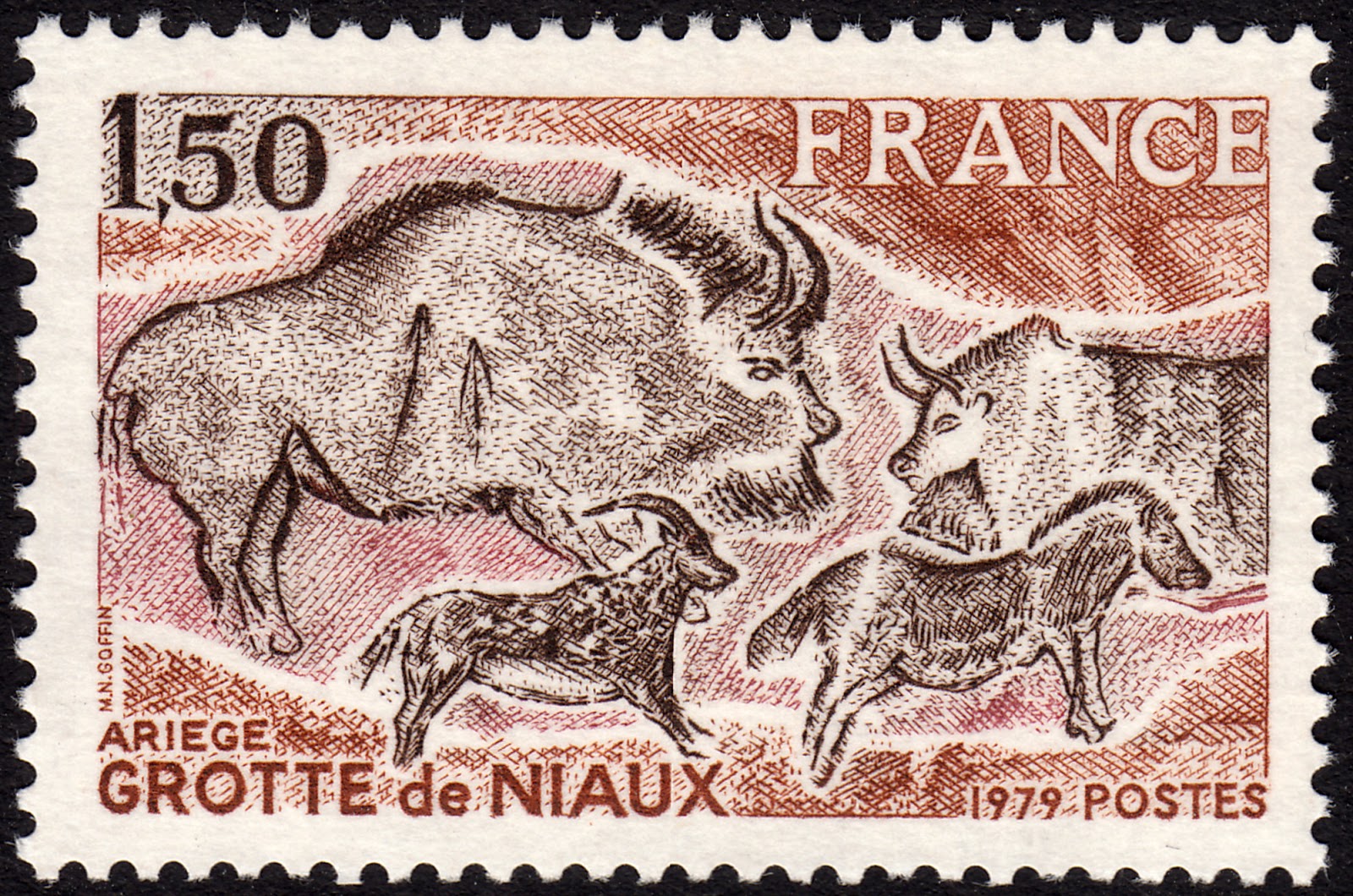
It almost defies the imagination to think that a moment of artist inspiration, somewhat loosely akin to the fictional account above, occurred in a cave in south-western France some 13,000 years ago and evidence of said event still exists today. In fact, the Cave of Niaux, Grotte de Niaux, is home to numerous galleries containing beautifully-rendered wall paintings. Archaeologists date the site to the Magdalenian period between 17,000 and 11,000 years ago. The artwork found in these cave galleries is typical of the style prevalent in the Magdalenian Period, called simply black-outlined style. One of the most well-known paintings is located in The Black Hall, Le Salon Noir
The predominating animal is the bison, represented in the upper part of the panel. The bison standing out in the left central part is usually catalogued as a female, due to the shapes presented, such as the scarcely prominent hump. By contrast and in opposition to this is the male, found on the right-hand side and showing a more prominent hump.
The lower part of the wall represents several horses which, with painted hair, represent a member of the equine family with a great amount of hair, the Przewalski. The bestiary is finished off with two goats, one represented in a very natural manner and the other in a totally schematic manner. The panel is dated as being 13,000 years old. (Wikipedia)
***

On 9 July, 1979, France issued a set of seven stamps in their ongoing Tourism series. In order to focus better on each stamp in this series, I will do a separate blog post for each. In this blog I'll take a close look at the 1,50 stamp, depicting artwork from the Cave of Niaux. This gorgeous stamp was designed and engraved by Marie-Noelle Goffin. 


Marie-Noelle Goffin has done a splendid job, reinvigorating this artwork and rendering it in stamp form for the world to share. Dominating the centre left of the stamp is a majestic bison, which as mentioned in the quote above, has been deemed by experts as a female due to that fact that it is depicted as possessing a small hump. 


***

The bison to the right is considered a male, due to its large hump. 


***

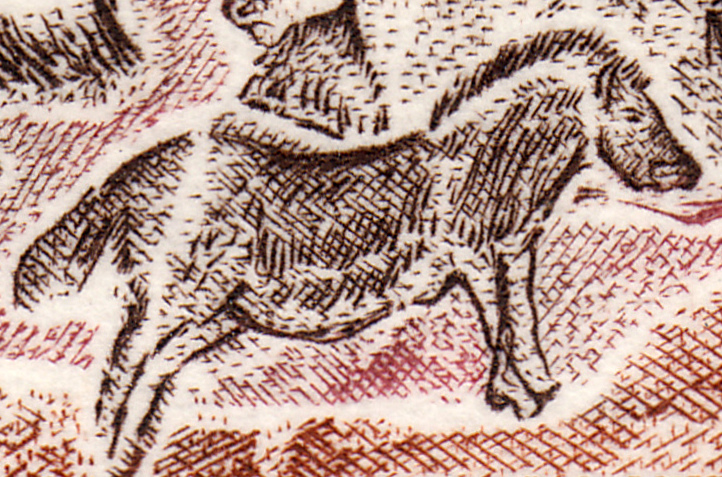
Elsewhere on the painting, we see a goat (bottom left) and a female horse (bottom right). 


***

This painting is a fasicnating snapshot into the paleo-world of France c. 13,000 years ago.

Until next time... 


Saturday, 28 April 2018

Andorra 1944 - Definitives (Part 2)

It was built in 1580 by the Busquet family in Andorra la Vella, the capital of Andorra. The "House of the Valley", or in Catalan, which happens to be the official language of Andorra, La Casade la Vall. Constructed in a rectangular fashion, the building includes a dovecote, which served as a defense tower and gives the complex the appearance of a small fortress.

In 1702 the house was acquired by the Consell de la Terra "Council of the Earth", which is an assembly comprising representatives of all the valleys. Once acquired, several areas of the house were converted to suit its new purpose more adequately. For example, the first floor became the new council chamber, in which was placed the "cabinet with seven keys". It takes this name "because it has seven locks each of whose keys is the property of the parishes of Andorra, and contain historical documents of the principality like the Manual Digest" (Wikipedia).

***

Between 1944 and 1947 Andorra issued a stunning set of twenty definitive stamps. The set includes four different designs, all engraved by Achille Ouvré. In this blog we shall study the second design in this set, depicting the House of the Valley. To study the first design, click HERE. It was designed and engraved by Achille Ouvré. This design was printed in five values, each with its own unique colour. All but one value, the 2,50f, which was issued in 1946, were issued in 1944. So let's now turn to the stamps. And I have to say,  I love this composition. There are so many areas of interest. The cottage and perimeter wall at the bottom right. The tiny minaret-like structure jutting from the corner of the building at the centre of the stamp. And in the background we are given a glimpse of the tower, behind which looms a stunning mountain range. 


***

Above I listed some of the key features I admire in this design. In fact, I believe each aspect deserves its very own close-up. For the purpose of these close-ups I have chosen to use the 3f brown-black, which is think showcases the details best.


Until next  time...


Wednesday, 25 April 2018

Andorra 1944 - Definitives (Part 1)

Constructed in the 11th century or possibly as late as the 12th century, the church of Saint Joan de Caselles (L’église Sant Joean de Caselles) is a stunning example of Andorran Romanesque art. The church is located in Canillo in the North-East of Andorra.

Upon entering the church one will immediately note its Romanesque church style: from the rectangular nave with wooden roof to the semicircular apse and Lombard style bell tower. And if you love to study interior decoration, this church won't disappoint on that front either. Perhaps one  of the most important pieces is the remains of a 12th century stucco depicting Christ. Around the stucco is a beautiful mural scene depicting the crucifixion with Longinus (the name given to the soldier who pierced Christ in his side with a spear) and Stefaton (the name given to the soldier who offered Christ a wine-soaked sponge), accompanied by the sun and the moon. If one were to venture beyond the gate behind the altar, you would be delighted to discover a magnificent altarpiece, depicting the life and martyrdom of Saint John, author of the Apocalypse (Revelations) and patron saint of the church. This altarpiece was influenced by the Italian and German Renaissance. 

***

Between 1944 and 1947 Andorra issued a stunning set of twenty definitive stamps. The set includes four different designs, all engraved by Achille Ouvré. In this blog we shall study the first design in this set, depicting the church of Saint Joan de Caselles. It was designed and engraved by Achille Ouvré. This design was printed in four values, each with its own unique colour. And all four values were issued in 1944.


I love the composition of this design. Ouvré has chosen an excellent angle to showcase the ruined church nestled in the surrounding mountains. In the foreground stands a person, perhaps a caretaker and a weary traveller. dominating the left of the design is the church's striking bell tower. Beautiful. I can't wait to explore the rest of Ouvré's work on this series. Stay tuned!

Until next time...


Monday, 16 April 2018

France 1951 - Modern Poets (Part 3)

"I'm now making myself as scummy as I can. Why? I want to be a poet, and I'm working at turning myself into a seer. You won't understand any of this, and I'm almost incapable of explaining it to you. The idea is to reach the unknown by the derangement of all the senses. It involves enormous suffering, but one must be strong and be a born poet. It's really not my fault." (Jean Nicolas Arthur Rimbaud, 1871. Wikipedia)
Some people turn to writing and expressing their deepest emotions with the power of words later in life, their copious experiences their thesaurus. In others, the spark is lit early in life, burns bright, then is snuffed out. 

Jean Nicolas Arthur Rimbaud, born 20 October 1854, started writing from a very young age, and it was quickly obvious he was a gifted poet. He was an excellent student, but perhaps stymied in the world of academia, he ran away to Paris as a teenager during the Franco-Prussian War. It was during this time that the words poured from his soul and he wrote many works of poetry, a lot of which was assembled in the book titled, Illuminations. Then inextricably, he completely stopped writing at the age of 21. He spent the rest of his brief life exploring several continents as a merchant. Tragically, he died of cancer just after his 37th birthday on 10 November 1891.   .

Rimbaud was known as quite a restless soul who loved hard and played harder. In 1871 Rimbaud had a torrid love affair with fellow poet Paul Verlaine (see Part 2 of this series for information on Verlaine). The next few years was a wild ride for the pair, spiced with absinthe, opium and hashish. Yet during this time Rimbaud still churned out the poetry, including one of his major works, A Season in Hell. Rimbaud is best known for his work with Symbolism and helping to ignite the flame of Surrealism. 

***

On 27 October 1951, France issued a set of three stamps celebrating modern French poets. The 15f value of the set depicts Jean Nicolas Arthur Rimbaud. This stamp was designed by Paul-Pierre Lemagny and engraved by Gabriel-Antoine Barlangue. It is worth mentioning that the portrait of Rimbaud used in this stamp was based on a portrait by Henri Fantin Latour.. 


The turbulent nature of this composition seems to mirror the wild life of Rimbaud. In the foreground we are faced with a youthful Rimbaud. His sits pensive, with hand on chin, perhaps ruminating over his next masterpiece. At the back left of the composition waterspouts (tornadoes on land) abound. Adrift in the churning maelstrom, a direct reflection of the poet's life, is a hapless ship, adrift, in dire need of respite. Behind the poet's shoulder to the right we see towering, snow-capped mountains and some butterfly-like creatures gamboling to some poetic tune only they can hear. In conclusion, what an awesome stamp!

Until next time...


Sunday, 8 April 2018

France 1951 - Modern Poets (Part 2)

It can ignite our deepest passions. It can awaken such emotional beasts as sadness and despair. It enables us to live vicariously through the magical use of words, whether in metre or rhyme. This is Poetry.

***

Paul-Marie Verlaine, born 30 March 1844, was a French poet whose work is associated with the Decadent movement. The Decadent movement was, at the time of Verlaine, a shattering new style with lurid themes such as self-disgust, general skepticism, delight in perversion, crude humor, and a belief in the superiority of human creativity over logic and the natural world. Indeed, this movement was considered the fin de siècle or turn of the century movement.

Verlaine considered himself, along with a host of contemporary poets such as Stéphane Mallarmé, Arthur Rimbaud, Aloysius Bertrand, Comte de Lautréamont, and Alice de Chambrier, to be a poète maudit "cursed poet". He and the other poets mentioned were scorned by critics for their new, brash style of poetry. But in 1886, just two years after calling himself a cursed poet, opinions were to change based on the publication of Jean Moréas' Symbolist Manifesto. This book introduced the idea of symbolism, and suddenly Decadent poetry and all its subtleties began to make some sense. Now Verlaine and other poets were being termed "Symbolists". Verlaine's work studied the notions of human will, fatality. the power of unconscious forces, and - quite radically - the theme of sex in various forms, including with prostitutes. Themes associated with delirium triggered by narcotics and alcohol were also to be found.

Despite the use of such strong themes, Verlaine pointed out the need for subtle suggestion as opposed to brutal statement. His purpose was "to evoke moods and feelings through the magic of words..." (Wikipedia). Verlaine actually described his style - this "turn  of the century" style - in great detail in his poem Art Poétique. He stresses the importance of musicality and elusiveness. Further, he stresses:
"Keep away from the murderous Sharp Saying, Cruel Wit, and Impure Laugh." 
As was the case with so many artistic minds of this era, Paul Verlaine was addicted to drugs and alcohol. In his later years he lived in the slums of Paris and public hospitals. He was often seen in cafes drowning his sorrows with copious glasses of absinthe. His drug and alcohol abuse finally got the better of him. He died in Paris at the age of 51 on 8 January 1896. 

***

On 27 October 1951, France issued a set of three stamps celebrating modern French poets. The 12f value of the set depicts Paul-Marie Verlaine. This stamp was designed by Paul-Pierre Lemagny and engraved by Charles-Paul Dufresne. You will note that  the stamp featured in Part 1 of this series was also designed by Paul-Pierre Lemagny. An immensely talented designer. It is worth mentioning that the portrait of Verlaine used in this stamp was based on a portrait by Eugène Carrière.


The composition of this stamp is fantastic.I love the way Verlaine stares directly at us, the viewer, as if ruminating on a new piece of poetic elusive symbolism. The design is also packed with stunning minute detail. Dufresne has done a masterful job in rendering the abundant flora to the left of the stamp. I particularly like, being a fan of engraved beards, the copious beard and moustache of Verlaine. In all, a brilliant composition. See below for a couple of close-ups.

***


Until next time...


Saturday, 7 April 2018

France 1951 - Modern Poets (Part 1)

Poetry can capture the mind, ensnare the soul, and grip the heart. It is the language of love and sorrow, the artistic expression of our deepest emotions. 

***

Charles Baudelaire, born 9 April 1821, was a French poet who possessed an original style of what can be considered prose-poetry. For the 19th century it was a radical, almost brutal, new style. Indeed, he himself is said to have coined the phrase "modernity". He uses this phrase to illustrate the fleeting nature of life in an ever-growing urban metropolis, in this instance Paris. He points out that it is the responsibility of the poet to capture this experience through the beauty of words. This theme is most evident in what can be considered his most famous collection of poems, entitled Les Fleurs du mal (The Flowers of Evil). According to one commentator at the time, his work was:
"immense, prodigious, unexpected, mingled with admiration and with some indefinable anxious fear". (Wikipedia)
If nothing else, Baudrlaire's work was bold. Indeed, in a poem entitled Au lecteur (To the Reader), which he uses as a preface to the collection, he actually goes so far as to accuse his readers of hypocrisy and of being as guilty of sins and lies as he himself. Pretty audacious!
... If rape or arson, poison or the knife
Has wove no pleasing patterns in the stuff
Of this drab canvas we accept as life—
It is because we are not bold enough! (Wikipedia)
Baudelaire was not only a poet. He was a skilled essayist and art critic. He was also a fan of the work of Edgar Allan Poe, and he spent quite a deal of his time translating his work into French. Baudelaire's unique style and honest approach to the modern lifestyle in his work has inspired a whole generation of poets including Paul Verlaine, Arthur Rimbaud and Stéphane Mallarmé to name just a few.

Baudelaire's addiction to laudanum, opium, and excessive drinking finally took  its toll on his body. In 1866 he suffered a massive stroke. He lived a further year in a semi-paralysed state. He died in Paris on 31 August 1867, aged just 46. Most of his poetry we are now familiar with was published posthumously by his mother to help recover some of the substantial debts he incurred due to his life  of "excesses".

***

On 27 October 1951, France issued a set of three stamps celebrating modern French poets. The 8f, and lowest, value of the set depicts Charles Baudelaire. This stamp was designed by Paul-Pierre Lemagny and engraved by Jean Pheulpin. I believe this is the first time I have featured a stamp engraved by Pheulpin in this blog. What a dreadful oversight. This engraver oozes talent, as you can see in the gorgeous stamp below.


The surreal, dreamlike quality of this design is truly breathtaking. There is detail in every nook and cranny. From the rather poignant depiction of a pensive Baudelaire to the owls off the right. And from the tall ship powering toward the left border of the stamp to the feral, somewhat demonic creature floating at the top left of the composition. Wow! Below I have included a few detail pictures, simply because I think this amazing design deserves some close-ups. Enjoy.


Until next time...


Thursday, 29 March 2018

France 1935 - Unemployed Intellectuals Stamps

It would become known as Black Tuesday. The stock market crash on October 29, 1929, had devastating ramifications, plunging the globe into The Great Depression. In France, the Depression didn't take root until 1931, but between 1931 and 1935, as its effects assumed a tighter stranglehold on the country, there was a marked increase in unemployment levels. Struck particularly hard were those previously employed in intellectual and artistic pursuits. In fact, jobs for intellectuals and artists had been on the decline since the conclusion of World War I. Indeed, a body known as the CTI (Confederation of Professional Workers) was created in 1919 in an attempt to aid intellectuals in re-injecting themselves into the workforce. So what exactly was the definition of an intellectual? According to the CIT:
"An intellectual worker is one who derives his livelihood from a work in which the effort of the mind, with what it entails, initiative and personality, usually prevails over physical effort " (Chariot, 2006) 
But however noble the cause of the CIT, it was not all that successful. Then on 6 February 1933, a body known as Help for Intellectual Workers (ETI) was created. This body and its president, Paul Grunebaum-Ballin, seemed to have far more insight than the CIT regarding potential schemes for the establishment of work for intellectuals and how to raise money to implement these schemes. One such scheme used as  its model an idea implemented in the US. Basically the idea was to provide jobs for intellectuals in public libraries performing such tasks as the "classification of books and the establishment of directories and catalogs." (Chariot, 2006)  But how does one raise funds to implement such an initiative? Simple. Surtax postage stamps!
"Surcharge stamps are "special stamps": the stamp has franking value only for its face value without the surcharge. It is not used to pay for a postal service. It is usually paid to a charity (In this case, intellectual aid)." (Chariot, 2006)
***

On 9 December 1935, France issued a set of two stamps, printed in recess, for the benefit of unemployed intellectuals. Master engraver, Achille Ouvré, was commissioned to design and engrave one stamp. The other stamp in the set was designed by René Grégoire and engraved by Omer Désiré Bouchery. Interestingly, this is the one and only stamp Omer Désiré Bouchery engraved for France. He was known primarily for his illustrations. A bit of a shame he didn't engrave more stamps; he certainly had a talent for it.

The stamp designed by René Grégoire and engraved by Omer Désiré Bouchery had a value of 50c with a surcharge of 10c to aid those unemployed intellectuals we spoke of earlier. This stamp features France, personified as a woman, lending aid to an intellectual. Interestingly, the setting of this stamp lends itself to the environment of a library.


***

The stamp designed and engraved by Achille Ouvré, and a favourite of mine, had a value of 50c with a surcharge of 2f, a much higher surcharge than the previous stamp. Perhaps a surcharge that was too steep, but we'll get to that in a moment. In this stamp we see a beautiful young woman representing the arts, holding a small lyre. Truly stunning.


***

Then on 14 October 1936, a little under a year later, this stamp was reissued with a brand new overprinted surcharge of 20c. Was 2f simply too much money to expect the average citizen to pay? Maybe. Maybe not. But it certainly makes for an interesting addition to any Ouvré collection.


Until next time...


Monday, 19 March 2018

I Muse...On Another Engraver to Study

I'm fairly certain that I'm not alone in thinking that over the years the French Post has had many, many incredibly talented artists on their payroll engraving stamps. So many in fact that it can be rather overwhelming trying to collect all of their amazing work. My strategy to date has been to choose a particular engraver, and then spent some time getting to know their work and their style. And along the way start putting together the bones of a collection.

***

Most recently I've become intrigued by the work of Jules Piel. I haven't looked at much of his work yet, but what I have seen really impresses me. His first engraving, which was part of a definitive set for Andorra in 1932 is a true thing of beauty. Unfortunately I don't have a copy of the design, which was printed in six values, just yet. But I did find the below image. 


Between 1932 and 1966 Jules Piel was a prolific engraver for both France and her various colonies. For a full bio, check out this blog post HERE. Indeed, many iconic French stamps were the work of this master engraver. Perhaps the most important of these was a set depicting Marshall Pétain, issued in 1941. 


Commencing in 1950, France began issuing a set of stamps on an annual basis with a surcharge to go to the Red Cross. Jules Piel engraved this first set of Red Cross stamps. In fact, he contributed to every set until his retirement from the French postal authority in 1966. And I was delighted to discover that not only did Jules Piel rack up an extensive array of stamps, but he also engraved quite a few banknotes! I must say, I'm really looking forward to delving more deeply into the work of this prolific artist.

Until next time...


Friday, 19 January 2018

France 1936 - Louis Blériot

What do truck headlights and astounding feats of aviation have in common? Louis Blériot, aviator, inventor, and engineer.

***

Louis Blériot, born 1 July 1872 in Cambrai, France, was drawn to engineering and design from at young age. Indeed, while attending the Institut Notre Dame in Cambrai, he won many class prizes for his engineering drawings. He then attended the prestigious École Centrale in Paris, after having spent a year gaining special tuition in order to pass the rigorous entrance exam. He graduated École Centrale around the middle of his class, which considering the high level of competition was a pretty decent result.

His first job was at an electrical engineering company in Paris, called Baguès. It was during this time that he came up with an invention, which would eventually bankroll his other passion, aviation. He designed and created the first ever practical headlamp (headlight) for automobiles. His new headlamp used a compact integral acetylene generator. In 1897, he decided to leave the company he had been working for and opened his own showroom in Paris, selling his headlamps. Turns out, this was an excellent business decision, for he quickly gained contracts with two of the foremost automobile manufacturers of the time, Renault and Panhard-Levassor.

Ever since his school days, Blériot had had an interest in aviation, but it wasn't until his visit to the 1900 Exposition Uniiverselle that he thought seriously about aircraft experimentation. It was seeing Clément Ader's Avion III, an experimental steam-powered aircraft, that seemed to really get his creative juices flowing. I can understand why. This 'plane' must have, at the time, seemed quite extraordinary. Check the Avion III out HERE

As I mentioned earlier, Blériot's headlamp business was going great guns so he could afford to splash about a bit of cash with some aviation experiments of his own. His initial experiments were with ornithopters, which are craft propelled by flapping wings, in the fashion of a bird. Many of these were powered by men with the wings strapped to their arms. Then they set about flapping like crazy in an attempt to achieve flight. Ornithopters have always been a bit hit and miss, and Blériot's attempts fell into the 'miss' column.

Then in 1905, he met a fellow aviation enthusiast, a man who would also later become his business partner, Gabriel Voisin. At the time Voisin was working for a fellow named, Ernest Archdeacon, on experimental gliders. Blériot, also an avid photographer, filmed Voisin the during the trials of a floatplane glider Voisin had built. Witnessing this event sparked Blériot into commissioning Voisin to build a similar plane for him. This plane, another glider, was called the Blériot II. Although this plane crashed and Voisin, who was flying it, nearly drowned, the two men were not deterred. Indeed, they soon established their own company, Ateliers d' Aviation Edouard Surcouf, Blériot et Voisin.

The partnership lasted until the end of 1906. During which time the pair built the Blériot III and IV, two powered aircraft that both proved unsuccessful. Their lack of success coupled with the success of rival aviator of Alberto Santos Dumont, who flew his 14-bis a distance of 220 m (720 ft), winning the Aéro Club de France prize for the first flight of over 100 metres, saw the dissolution of the pafrtnership.

After the partnership with Voisin, Louis Blériot established his own business, Recherches Aéronautiques Louis Blériot, This business was primarily funded by Blériot, who employed his own engineers and designers. Over the next couple of years Blériot developed a whole series of aircraft, bearing his name, each one slightly better than the rest. This aircraft research culminated in the construction of the Blériot XI.

At 4:41 am on the 25 July 1909 Blériot made history in his Type XI by setting off from Calais, France in an attempt to cross the English Channel. "Flying at approximately 45 mph (72 km/h) and an altitude of about 250 ft (76 m), he set off across the Channel. Not having a compass, Blériot took his course from the Escopette, which was heading for Dover, but he soon overtook the ship." (Wikipedia)

During the crossing, visibility rapidly deteriorated. In fact, Blériot later said, “for more than 10 minutes I was alone, isolated, lost in the midst of the immense sea, and I did not see anything on the horizon or a single ship”.

Thankfully, a short time later, Blériot spotted the English coast. Unfortunately for Blériot, he had not previously visited Dover to find a good spot to land, so he had to wing it. After spotting Charles Fontaine, the correspondent from Le Matin waving a large Tricolour as a signal, Blériot "circled twice to lose height, and cut his engine at an altitude of about 20 m (66 ft), making a heavy 'pancake' landing due to the gusty wind conditions; the undercarriage was damaged and one blade of the propeller was shattered, but Blériot was unhurt. The flight had taken 36 minutes and 30 seconds." (Wikipedia) Thus history was made!

***

On 21 November 1934, France issued a stamp celebrating the 25th anniversary of Louis Blériot's English Channel crossing. The stamp was designed and engraved by Achille Ouvré. It is a stunning design featuring a map of the English Channel overlaid by Blériot's Type XI aircraft.


Until next time...


Monday, 20 November 2017

Monaco 1977 - The Career of a Navigator 1st Issue (Part 2)

Oceanography is: "a science that deals with the oceans and includes the delimitation of their extent and depth, the physics and chemistry of their waters, marine biology, and the exploitation of their resource" (Meriam-Webster.com).

***

In last week's blog we were introduced to Prince Albert I of Monaco, a trail-blazer in the field of oceanography. His contributions to this discipline and his career as a navigator were celebrated in a sumptuous series of 18 stamps, issued in two sets of nine in 1977.

One of Prince Albert's crowning achievements was the founding of the Oceanographic Institute in 1906. One part of the institute is the Monaco Oceanographic Museum, located in Monaco-ville. The museum is a  stunning piece of architecture in the baroque revival style. It was built into the side of a cliff face overlooking the ocean, and it took workers some eleven years to complete.


***

The museum was inaugurated in 1910 by Prince Albert I. In looking up the history of the museum, I was surprised to discover that the great Jacques Cousteau was the director of the museum from 1957 to 1988. I recall watching Mr Cousteau on TV as a kid. The singer/songwriter John Denver wrote a song dedicated to him, called Calypso, which was the name of Cousteau's boat. The museum is also known as the Jacques Cousteau Museum.

The museum is home to a large variety of sea fauna such as starfish, turtles, sea urchins ,jellyfish, crabs, sharks, lobsters and many more sea critters. There are even some skeletons!


It is also home to an amazing octopus sculpture.


***

In 1902 Albert I published a book La Carriere d'un Navigateur (The Career of a Navigator), which documents his adventurous life at sea. On 3 May 1977, the 75th anniversary of the publication of his magnum opus, Monaco issued a glorious set of 18 stamps, issued in two sets of nine, honouring the Prince's achievements. To engrave this mammoth issue, a stellar cast of French engravers was enlisted: Pierre Gandon, Claude Haley, Michel Monvoisin, George Betemps, and Pierre Forget. This set was created based on illustrations by the French illustrator Louis Tinayre (14 March 1861-26 September 1942).

Last week we kicked off by studying the first four stamps in this first series. This week we will study the last five stamps in this series. And they are truly gorgeous. Maintenant examinons les timbres!

***

The 1f stamp was designed and engraved by Georges Betemps. It features a night-watch helmsman at the wheel of one of Prince Albert's yachts, perhaps l'hirondelle. I love this stamp. The depths of the darkness give it a sense of brooding mystery. And the illumination from the binnacle lamps splashing over the sailor is fabulous.


***

The 1f 25 stamp was designed and engraved by Pierre Forget. It features a dynamic scene in which L'hirondelle battles a raging storm. The artist has managed to create a very real sense of fear and impending danger in this stamp.


***

The 1f 40 stamp was designed and engraved by Claude Haley. It features a group of researchers, perhaps including Prince Albert himself, out in a longboat, fishing for shrimp.


***

The 1f 90 stamp was designed and engraved by Pierre Forget. It features a scene in which the trawl is being hauled aboard for further investigation. 


***

The 2f 50 stamp was designed and engraved by Georges Betemps. It features the capture of an oceanic sunfish for analysis.


Stay tuned for the second series of this wonderful set.

Until next time...