Wednesday, 12 June 2019

France 1979 - Tourism Series (Part 1)

He raised the torch high, the firelight casting dancing demon-shadows across the irregular cave walls. He ran a calloused hand with delicate precision across the rough surface. A smile creased his face. Yes, yes. This spot would do very nicely. He set down the torch, stepped up to the rocky canvas, and began working in earnest.

***

It almost defies the imagination to think that a moment of artist inspiration, somewhat loosely akin to the fictional account above, occurred in a cave in south-western France some 13,000 years ago and evidence of said event still exists today. In fact, the Cave of Niaux, Grotte de Niaux, is home to numerous galleries containing beautifully-rendered wall paintings. Archaeologists date the site to the Magdalenian period between 17,000 and 11,000 years ago. The artwork found in these cave galleries is typical of the style prevalent in the Magdalenian Period, called simply black-outlined style. One of the most well-known paintings is located in The Black Hall, Le Salon Noir
The predominating animal is the bison, represented in the upper part of the panel. The bison standing out in the left central part is usually catalogued as a female, due to the shapes presented, such as the scarcely prominent hump. By contrast and in opposition to this is the male, found on the right-hand side and showing a more prominent hump.
The lower part of the wall represents several horses which, with painted hair, represent a member of the equine family with a great amount of hair, the Przewalski. The bestiary is finished off with two goats, one represented in a very natural manner and the other in a totally schematic manner. The panel is dated as being 13,000 years old. (Wikipedia)
***

On 9 July, 1979, France issued a set of seven stamps in their ongoing Tourism series. In order to focus better on each stamp in this series, I will do a separate blog post for each. In this blog I'll take a close look at the 1,50 stamp, depicting artwork from the Cave of Niaux. This gorgeous stamp was designed and engraved by Marie-Noelle Goffin. 
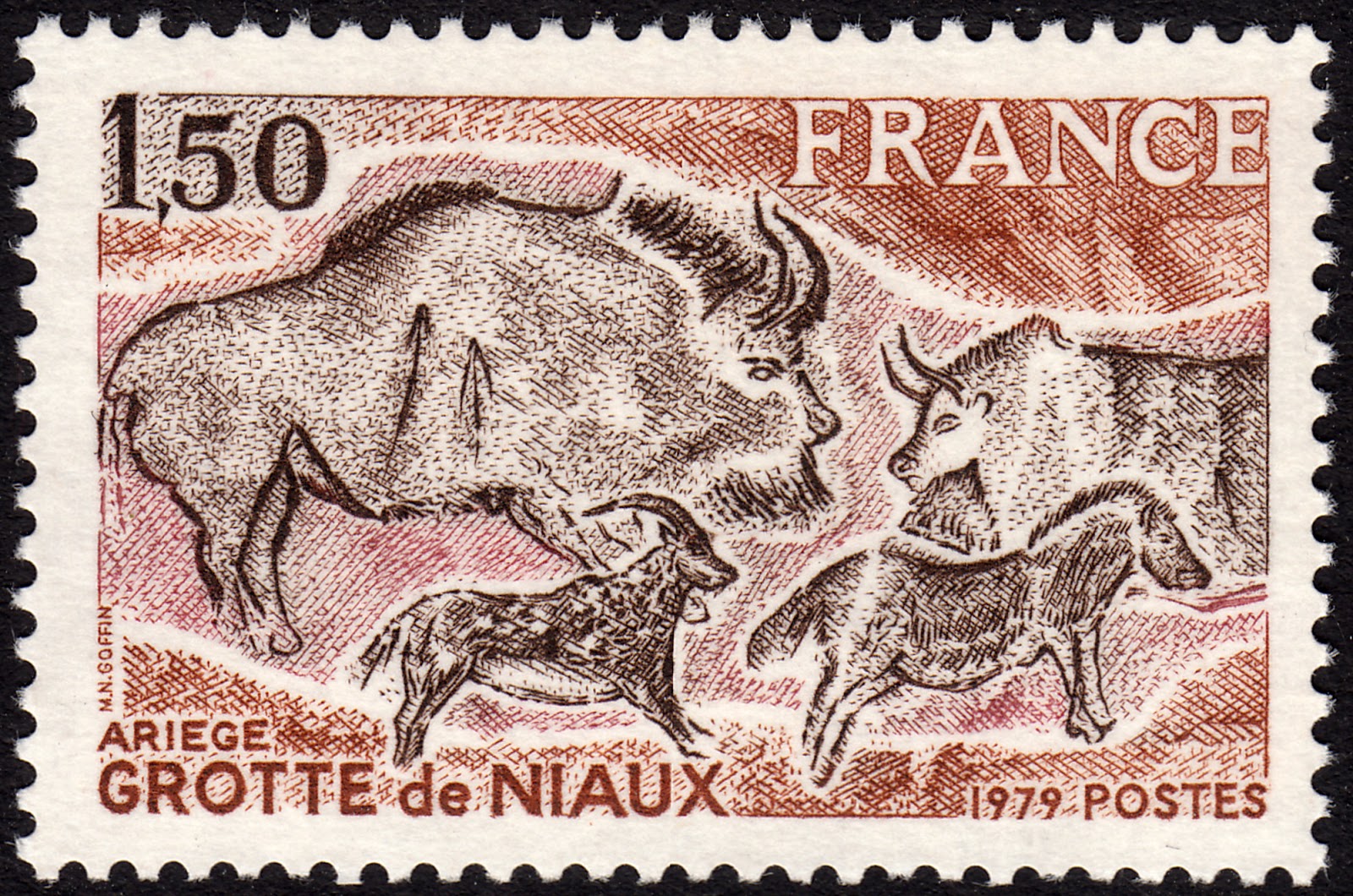

Marie-Noelle Goffin has done a splendid job, reinvigorating this artwork and rendering it in stamp form for the world to share. Dominating the centre left of the stamp is a majestic bison, which as mentioned in the quote above, has been deemed by experts as a female due to that fact that it is depicted as possessing a small hump. 


***

The bison to the right is considered a male, due to its large hump. 


***

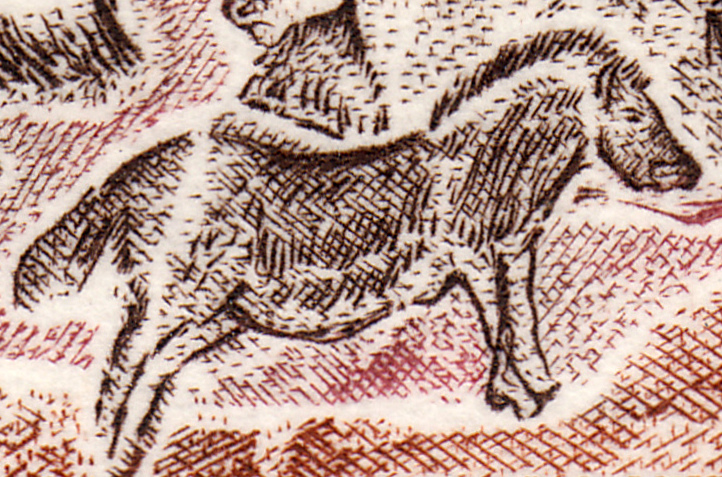
Elsewhere on the painting, we see a goat (bottom left) and a female horse (bottom right). 


***

This painting is a fasicnating snapshot into the paleo-world of France c. 13,000 years ago.

Until next time... 


Saturday, 28 April 2018

Andorra 1944 - Definitives (Part 2)

It was built in 1580 by the Busquet family in Andorra la Vella, the capital of Andorra. The "House of the Valley", or in Catalan, which happens to be the official language of Andorra, La Casade la Vall. Constructed in a rectangular fashion, the building includes a dovecote, which served as a defense tower and gives the complex the appearance of a small fortress.

In 1702 the house was acquired by the Consell de la Terra "Council of the Earth", which is an assembly comprising representatives of all the valleys. Once acquired, several areas of the house were converted to suit its new purpose more adequately. For example, the first floor became the new council chamber, in which was placed the "cabinet with seven keys". It takes this name "because it has seven locks each of whose keys is the property of the parishes of Andorra, and contain historical documents of the principality like the Manual Digest" (Wikipedia).

***

Between 1944 and 1947 Andorra issued a stunning set of twenty definitive stamps. The set includes four different designs, all engraved by Achille Ouvré. In this blog we shall study the second design in this set, depicting the House of the Valley. To study the first design, click HERE. It was designed and engraved by Achille Ouvré. This design was printed in five values, each with its own unique colour. All but one value, the 2,50f, which was issued in 1946, were issued in 1944. So let's now turn to the stamps. And I have to say,  I love this composition. There are so many areas of interest. The cottage and perimeter wall at the bottom right. The tiny minaret-like structure jutting from the corner of the building at the centre of the stamp. And in the background we are given a glimpse of the tower, behind which looms a stunning mountain range. 


***

Above I listed some of the key features I admire in this design. In fact, I believe each aspect deserves its very own close-up. For the purpose of these close-ups I have chosen to use the 3f brown-black, which is think showcases the details best.


Until next  time...


Wednesday, 25 April 2018

Andorra 1944 - Definitives (Part 1)

Constructed in the 11th century or possibly as late as the 12th century, the church of Saint Joan de Caselles (L’église Sant Joean de Caselles) is a stunning example of Andorran Romanesque art. The church is located in Canillo in the North-East of Andorra.

Upon entering the church one will immediately note its Romanesque church style: from the rectangular nave with wooden roof to the semicircular apse and Lombard style bell tower. And if you love to study interior decoration, this church won't disappoint on that front either. Perhaps one  of the most important pieces is the remains of a 12th century stucco depicting Christ. Around the stucco is a beautiful mural scene depicting the crucifixion with Longinus (the name given to the soldier who pierced Christ in his side with a spear) and Stefaton (the name given to the soldier who offered Christ a wine-soaked sponge), accompanied by the sun and the moon. If one were to venture beyond the gate behind the altar, you would be delighted to discover a magnificent altarpiece, depicting the life and martyrdom of Saint John, author of the Apocalypse (Revelations) and patron saint of the church. This altarpiece was influenced by the Italian and German Renaissance. 

***

Between 1944 and 1947 Andorra issued a stunning set of twenty definitive stamps. The set includes four different designs, all engraved by Achille Ouvré. In this blog we shall study the first design in this set, depicting the church of Saint Joan de Caselles. It was designed and engraved by Achille Ouvré. This design was printed in four values, each with its own unique colour. And all four values were issued in 1944.


I love the composition of this design. Ouvré has chosen an excellent angle to showcase the ruined church nestled in the surrounding mountains. In the foreground stands a person, perhaps a caretaker and a weary traveller. dominating the left of the design is the church's striking bell tower. Beautiful. I can't wait to explore the rest of Ouvré's work on this series. Stay tuned!

Until next time...


Monday, 16 April 2018

France 1951 - Modern Poets (Part 3)

"I'm now making myself as scummy as I can. Why? I want to be a poet, and I'm working at turning myself into a seer. You won't understand any of this, and I'm almost incapable of explaining it to you. The idea is to reach the unknown by the derangement of all the senses. It involves enormous suffering, but one must be strong and be a born poet. It's really not my fault." (Jean Nicolas Arthur Rimbaud, 1871. Wikipedia)
Some people turn to writing and expressing their deepest emotions with the power of words later in life, their copious experiences their thesaurus. In others, the spark is lit early in life, burns bright, then is snuffed out. 

Jean Nicolas Arthur Rimbaud, born 20 October 1854, started writing from a very young age, and it was quickly obvious he was a gifted poet. He was an excellent student, but perhaps stymied in the world of academia, he ran away to Paris as a teenager during the Franco-Prussian War. It was during this time that the words poured from his soul and he wrote many works of poetry, a lot of which was assembled in the book titled, Illuminations. Then inextricably, he completely stopped writing at the age of 21. He spent the rest of his brief life exploring several continents as a merchant. Tragically, he died of cancer just after his 37th birthday on 10 November 1891.   .

Rimbaud was known as quite a restless soul who loved hard and played harder. In 1871 Rimbaud had a torrid love affair with fellow poet Paul Verlaine (see Part 2 of this series for information on Verlaine). The next few years was a wild ride for the pair, spiced with absinthe, opium and hashish. Yet during this time Rimbaud still churned out the poetry, including one of his major works, A Season in Hell. Rimbaud is best known for his work with Symbolism and helping to ignite the flame of Surrealism. 

***

On 27 October 1951, France issued a set of three stamps celebrating modern French poets. The 15f value of the set depicts Jean Nicolas Arthur Rimbaud. This stamp was designed by Paul-Pierre Lemagny and engraved by Gabriel-Antoine Barlangue. It is worth mentioning that the portrait of Rimbaud used in this stamp was based on a portrait by Henri Fantin Latour.. 


The turbulent nature of this composition seems to mirror the wild life of Rimbaud. In the foreground we are faced with a youthful Rimbaud. His sits pensive, with hand on chin, perhaps ruminating over his next masterpiece. At the back left of the composition waterspouts (tornadoes on land) abound. Adrift in the churning maelstrom, a direct reflection of the poet's life, is a hapless ship, adrift, in dire need of respite. Behind the poet's shoulder to the right we see towering, snow-capped mountains and some butterfly-like creatures gamboling to some poetic tune only they can hear. In conclusion, what an awesome stamp!

Until next time...