Sunday, 25 June 2017

France 1957 - Stamp Day

A felucca is a wooden sailing boat that is not only small and lightweight, but also extremely maneuverable. These characteristics make this style of boat perfect for rivers and protected waters. They are commonly found plying the waters of the Mediterranean and the Nile in Egypt. A felucca can be easily identified by its large triangular sails, which are called lateen sails. A felucca can be rigged with two or three lateen sails.

By the 18th century the popularity of this versatile craft spread to Italy and along the French Riviera. Here they were often used as passenger craft and for transporting items such as mail. By this point it was not uncommon to see feluccas fitted with up to twelve oars and a canopy at the stern to protect its passengers from the weather. There is a rather quaint mention of the use of a felucca in a mid 18th century travel book.
The most agreeable carriage from hence (Nice) to Genoa, is a felucca, or open boat, rowed by ten or twelve stout mariners. Though none of these boats belng to Nice, they are to be found every day in our harbour waiting for a fair to Genoa... A felucca is large enough to take in a post-chaise; and there is a tilt over the stern sheets where the passengers sit to protect them from the rain. Between the seats one person may lie commodiously upon a mattress, which is commonly supplied by the patron. ... I would advise every valetudinarian who travels this way, to provide his own chaise, mattress, and bed-linen, otherwise he will pass his time very uncomfortably. (Smollet, London, 1884, p 746)
Towards the end of the 18th century the popularity of feluccas had travelled even farther afield, all the way to the west coast of USA. To San Francisco to be exact. In 1884 a whole fleet of feluccas was put to work in the bay as fishing trawlers.

***

Over the years France has issued some stunning stamps to celebrate Stamp Day. The stamp chosen for Stamp Day 1957 was no exception. In fact, it is one of my personal Stamp Day favourites. The stamp in question was designed and engraved by Albert Decaris, and it was issued on 18 March 1957. Like other Stamp Day issues it was a semi-postal with a value of 12f + 3f. The 3f surcharge went to the French Red Cross.


The subject of the design was an 18th century feluccia, which, as mentioned above, often carried mail. Decaris had a tremendous liking for maritime engravings, a passion which is clearly evident in this design. I think it is superb. The sleek lines of the hull slciing through the water. The sails billowing as they snatch the cool breeze. And the oars, poised for another stroke...

***

I also have a copy of this lovely stamp in a border pair, which is sublime.


Until next time...


Tuesday, 20 June 2017

France 1941 - Reims Coat of Arms

The city of Reims, located about 130 km to the northeast of Paris, has seen quite a checkered history. From an ally of the Roman Empire to the location of a Christian miracle, and from bloody battles to wine-making. But I get ahead of myself! To proper discover the story of Reims we must jump in the Stamp Crazy Time Machine and travel back over 2000 years. So strap yourself in...

The area that became Reims (also spelled Rheims) was founded by the Gaul tribe known as the Remi and used as their capital. In 80 BC after the Roman conquest of northern Gaul, the area was made a Roman town, called Durocortōrum "round fortress". The Remi people, still living in the town, allied themselves with Rome during Julius Caesar's invasion (58-50 BC). They remained loyal to Rome during the subsequent Gallic insurrections that resulted from the invasion. Their fealty was rewarded, and subsequently the city grew. At the height of Rome's power the population possibly reached somewhere in the region of 100,000. More conservative estimates place it as between 30,000-50,000.

Over the course of the next five centuries the city was the site of several invasions. In 406 it was captured by the Vandals. In 451 Attila the Hun stormed in and put the city to the sword. Then in 496 perhaps one of the most momentous events in the city's history occurred shaping its destiny for centuries to come. Ten year after his victory at Soissons in 486, Clovis, King of the Salian Franks, was baptised in the city in the Abbey of Saint-Remi. He was baptised using the oil of the sacred phial, which was supposedly delivered by a dove from heaven specifically for the occasion. These supernatural events became a symbol for the monarchy's divine right to rule. Over time Reims became the traditional site of the crowning of the kings of France. The crowning ceremonies were held in Notre-Dame de Reims "Our Lady of Reims". This Cathedral is now a World Heritage Site and a popular tourist destination.

These days Reims is one of the main centres of Champagne production. In fact, many of the largest production houses in France, known as les Grandes Marques. Interestingly, the city of Reims sits atop a maze of tunnels and caves cut into the chalk. These caves, some dating back to Roman times, are used to store champagne while it ages.

***

On 15 December 1941, France issued the first of two series of semi-postal stamps. The surcharge on these stamps went to National Aid. The theme for the series was Coats of Arms of France. The 3f + 5f Coat of Arms of Reims stamp is the focus of this blog.This stamp was designed and engraved by Pierre Gandon. 


I spent a bit of time researching the Coat of Arms of Reims without much success. So I'm going to hazard a guess as to the meaning of the three main parts of the shield. I have created a key, see the image below, for ease of discussion.


  1. These branches are bay laurel (Laurus nobilis), which is used for laurel wreaths. Bay laurel can often be found on a Coat of Arms. They signify victory and glory.
  2. Here we have the "fleur-de-lis (sometimes spelled "fleur-de-lys") or "flower of the lily." This symbol, depicting a stylized lily or lotus flower, has many meanings. Traditionally, it has been used to represent French royalty, and in that sense it is said to signify perfection, light, and life.
  3. Surmounting the shield is a crown, which usually signifies sovereignty and empire. In this instance it could also refer to the fact that the city was the place where French kings were crowned. The crown here is shaped like ramparts which can symbolise strength and stability.
  4. The Coat of Arms motto is Dieu en Soit Garde. This I have been told basically means God, protect us.
  5. And the last thing, you will notice on the bottom of the shield on the stamp two crosses. The one on the  right hand side is the Croix de Guerre, and the left one is the Croix de la Legion.
As an interesting little finishing note, I have noticed the Gandon signed his early work for France "P.Gandon".


Until next time... 

Friday, 16 June 2017

France 1949 - Franco-American Alliance

It all started in 1776 when a young colony rebelled against its motherland in an attempt to smash the shackles of bondage. This colony called upon the aid of France to assist in their struggles for independence. In 1778, France and the new United States signed a treaty of alliance. With foreign aid this colony eventually won their war for independence in 1783. You may have heard the name of this colony once or twice. It now goes by the name: United States of America. This alliance solidified relations between the two nations, and except for two occasions in 1798 and 1942 they managed to maintain fairly peaceful relations. Indeed, in 1884 France gifted America with the stunningly beautiful Statue of Liberty as a symbol of friendship.

For the sake of brevity, we can skip forward to a little over one hundred years later. It is 1949. World War II is thankfully over. And after some rocky relations since the end of the war, the two nations of France and the USA have became formal allies as part of the North Atlantic Treaty. From this treaty was formed the NATO military alliance. But it was not all smooth sailing between the two nations. The Suez Crisis in 1956, for instance, caused a substantial amount of friction between the two countries. In the end, however, the two countries have maintained a reasonable relationship. Indeed, over the years the young people of France have embraced many cultural aspects of the US. Whether the bombardment of US culture on other nations is a good thing or a bad thing is not really for me to say - at least not here! 

This is, of course, an astoundingly brief summary of historical events from 1766 to the present. To go further would require a ridiculously long blog. To read more on the history of the relationship between France and the USA click HERE

***

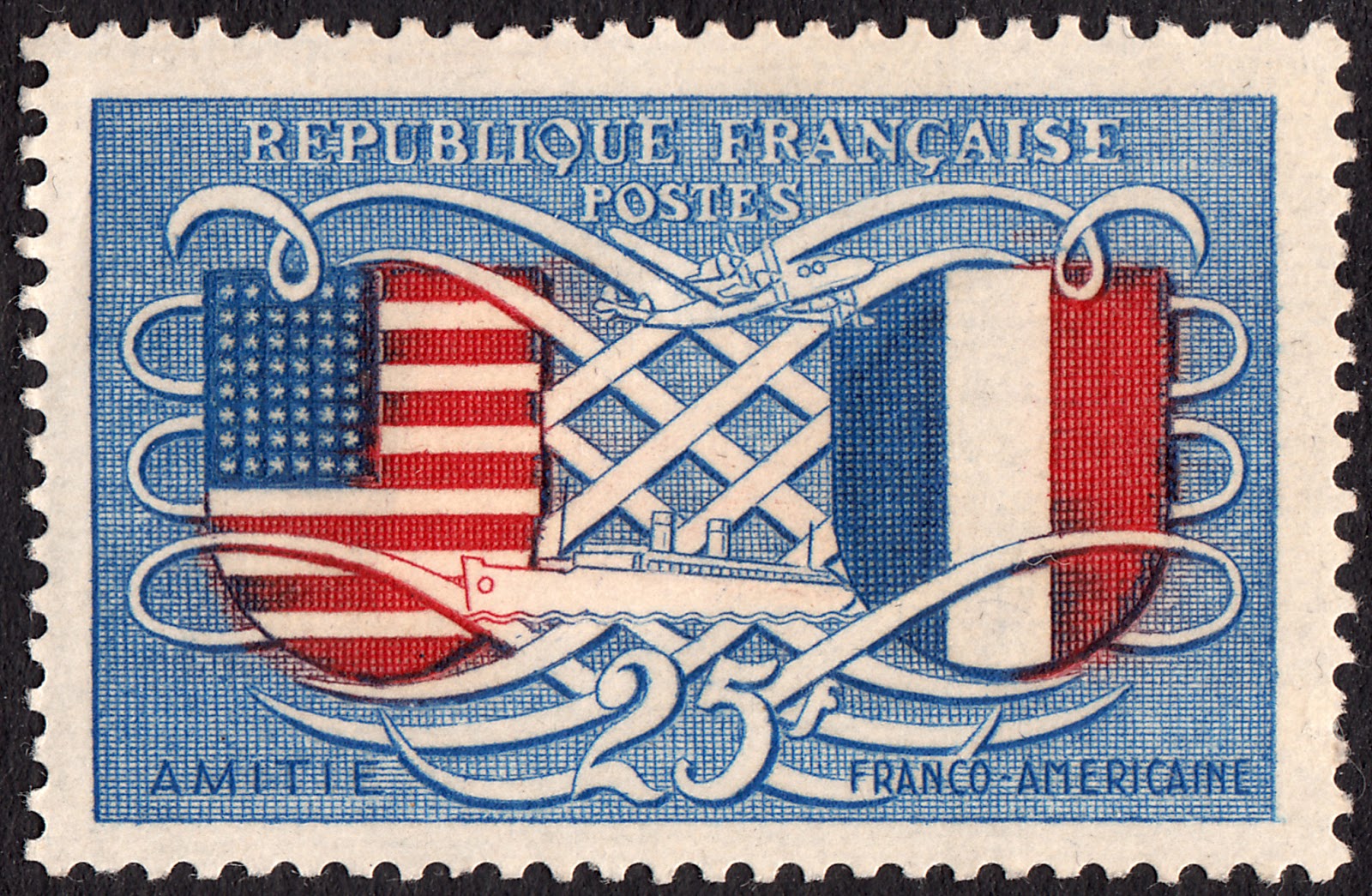
On 14 May 1949 France issued a stamp to celebrate the formal alliance between France and USA. The stamp was engraved by Pierre Gandon.


This elegant design represents the allied nations as shields bearing their respective flags. Between the shield is worked a cross-hatch pattern to represent the weaving together of two countries via trade and travel. This concept is furthered by the illustration of a plane, top centre, and a transatlantic ship, lower centre. Altogether this is a solid design with a dramatic visual punch.

Until next time...


Tuesday, 13 June 2017

France 1949 - United Nations in Paris

The atrocities of World War II must never again be allowed to occur! This was the basic premise to the formation of the United Nations. Without going into lots of details, the United Nations was established on 24 October 1945, a replacement to the League of Nations, which did not work as well as intended. Initially 51 member states signed up to join the UN. These days that number has risen to 193. 

The official headquarters of the UN is located in Manhattan, New York City with three further offices in Geneva, Nairobi, and Vienna. Its objectives have outgrown its initial premise somewhat. It strives to maintain international peace and security, and it seeks to promote human rights through things like humanitarian aid during times of crisis such as famine, natural disaster, and war. The UN also works to protect our natural environment.

In order to run effectively, the UN mechanism has six main components (from Wikipedia):
  1.  General Assembly (the main deliberative assembly)
  2. Security Council (for deciding certain resolutions for peace and security)
  3. Economic and Social Council (ECOSOC; for promoting international economic and social co-operation and development)
  4. Secretariat (for providing studies, information, and facilities needed by the UN)
  5. International Court of Justice (the primary judicial organ)
  6. UN Trusteeship Council (inactive since 1994)
For this blog post our main focus is the General Assembly. The first session of the UN General Assembly was convened on 10 January 1946 in the Methodist Central Hall in London and included representatives of 51 nations. But since an official headquarters had as yet been created, the next five sessions of the Assembly were held in different locations. Two such sessions were held in Paris. The first Paris session was in 1948. The second Paris session began on 6 November 1951. This session was held at the Palais de Challiot
\
The Palais de Challiot was built for the Exposition Internationale of 1937, on the site where the old Palais du Trocadéro had stood before being demolished. It is perhaps worth noting that Adolf Hitler was pictured on the front terrace of the palace with the Eiffel Tower in the background during his tour of Paris in 1940. This photo became an iconic image of World War II.

***

On 6 November 1951 France issued a set of two stamps bearing the same design for the opening of the UN General Assembly in Paris. This issue was designed and engraved by Albert Decaris. The design features the Palais de Challiot in the foreground with the Eiffel Tower standing proudly in the centre background. This design was issued in two values, each with its own colour.


***

One thing I find interesting about this issue is the 18f red. The ink seems to be quite thick, which blurs much of the fine detail. This is reminiscent of the 1948 Luxembourg Palace 12f issue printed in carmine. In the Luxembourg Issue a lot of details are blotted out. This is perhaps a reflection of the consistency of the red pigmented ink of this vintage.  


Until next time...